Upcoming courses and events
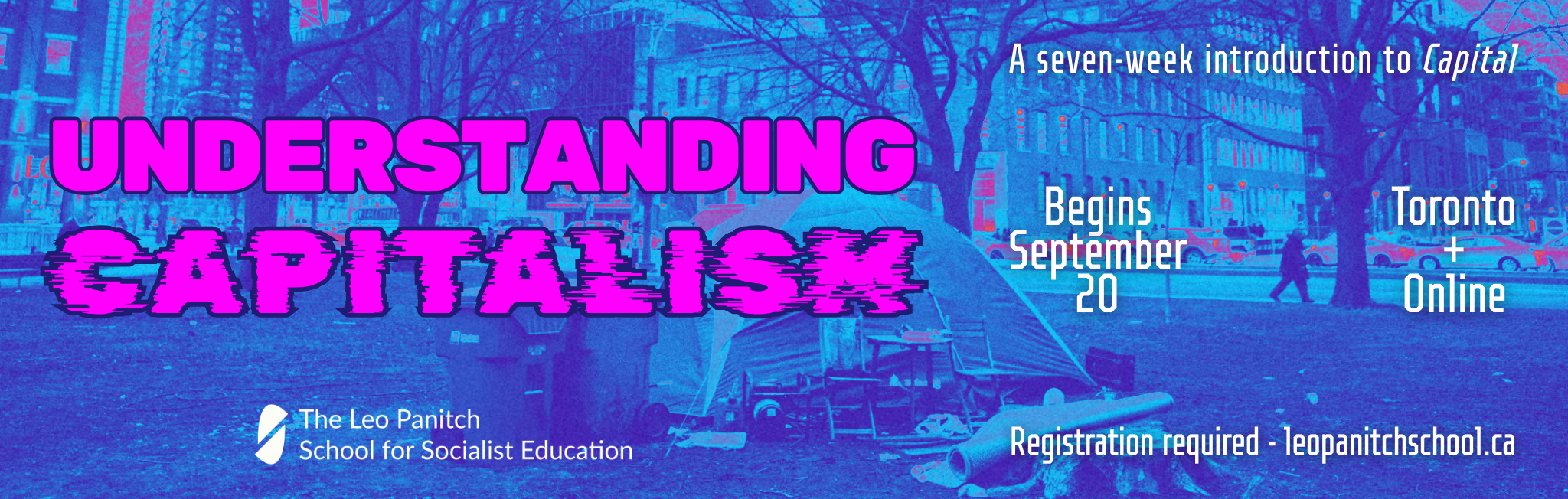
September 20, 2026
Toronto, ON + Online
An important note from the organizers: As this is a pilot version of the course, online participation may be limited in order to ensure a manageable class size for our instructors. In person participation is highly recommended for those in the Greater Toronto Area.
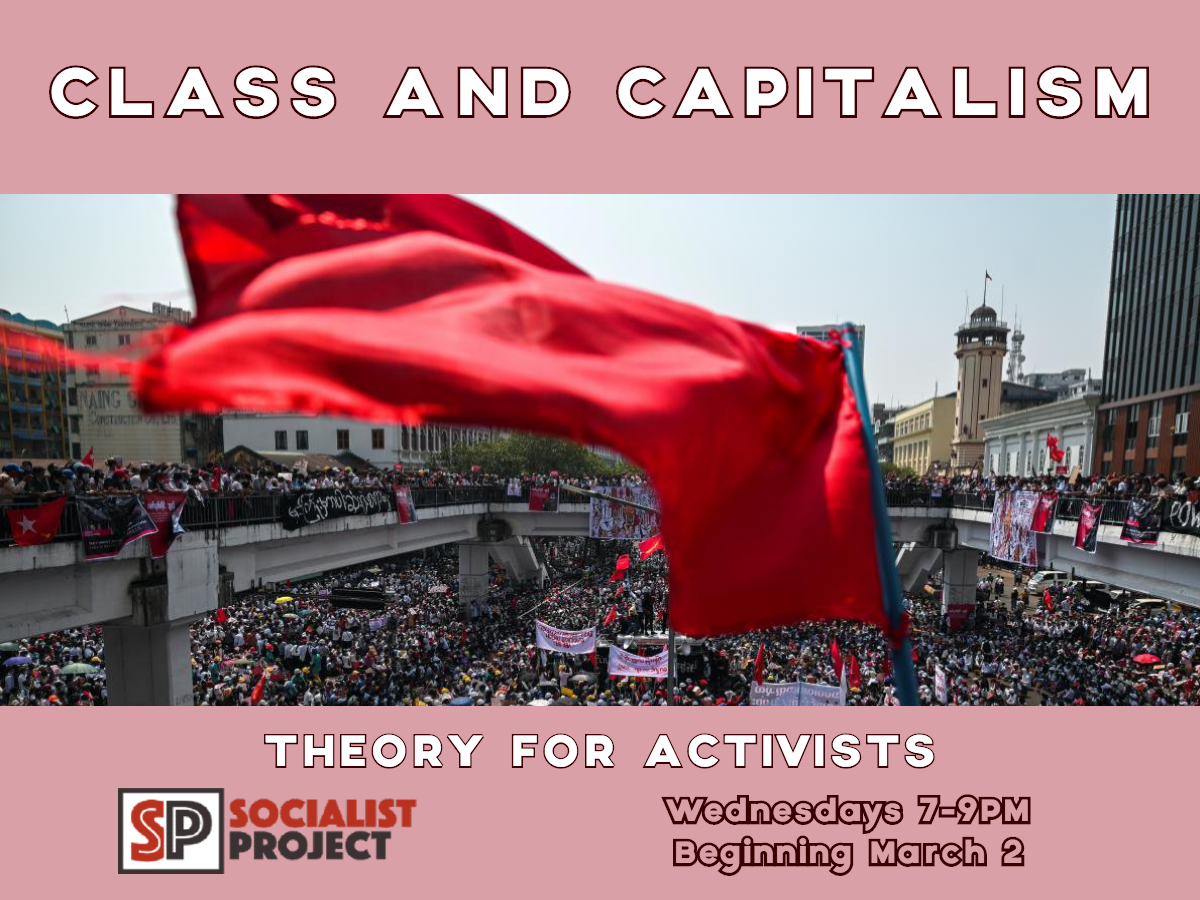
Frustrated with capitalism and its impacts on human beings and the planet? Do you believe that a more equitable, democratic, and liberatory society is possible?
Waking up from the capitalist nightmare requires a clear understanding of what we are up against: how we understand capitalism, how it works, and how it compels us to act in certain ways – these all shape what kinds of strategies will be needed to move beyond it.
This course will approach these questions and others through An Introduction to the Three Volumes of Karl Marx’s Capital by Michael Heinrich, one of most approachable and understandable guides through Marx’s masterwork. Capital remains the most important work of critical analysis of capitalism in history, through its exploration of the economic principles that govern capitalism, and the problems faced by workers and society.
Why not just read Capital directly? Capital is infamously long and difficult! Many aspiring socialist activists over the years have plunged in head first, only to find the language daunting and the ideas hard to grasp. Heinrich’s book gives a compact, concise, and clear presentation of the main points, providing a solid understanding of how capitalism functions.
We will discuss the most common questions raised by Heinrich’s book (and Marx’s three volumes of Capital), as well the political and practical relevance of the material today. Understanding capitalism isn’t just an intellectual exercise, it’s a key part of how we begin to build a better world!
When – Sunday September 20, weekly until November 8. All classes 2-5pm
Where – Toronto ON + Online
How – Advance registration required
Cost – Free/recommended donation: $40
All are welcome to this introductory 7-week course. Whether you’re just dipping your toes into socialist politics and full of questions, or an experienced activist wanting to revisit your understanding of capitalism, we’d love for you to join us!
Participants will be asked to read along as we work our way through a 220 page book over seven weeks. A free PDF or at-cost physical copy of the book will be made available.
The course will be taking place both in-person in Toronto, and online via Zoom, upon request. Please note that space for this course is limited and selections may be made to ensure a participant group with a variety of experiences.
Accessibility
The venue for this event is wheelchair accessible and features multiple gender neutral washrooms. We ask that participants refrain from wearing perfume or other scented products. Please contact us with any accessibility concerns.
September 27, 2026
Burnaby, BC
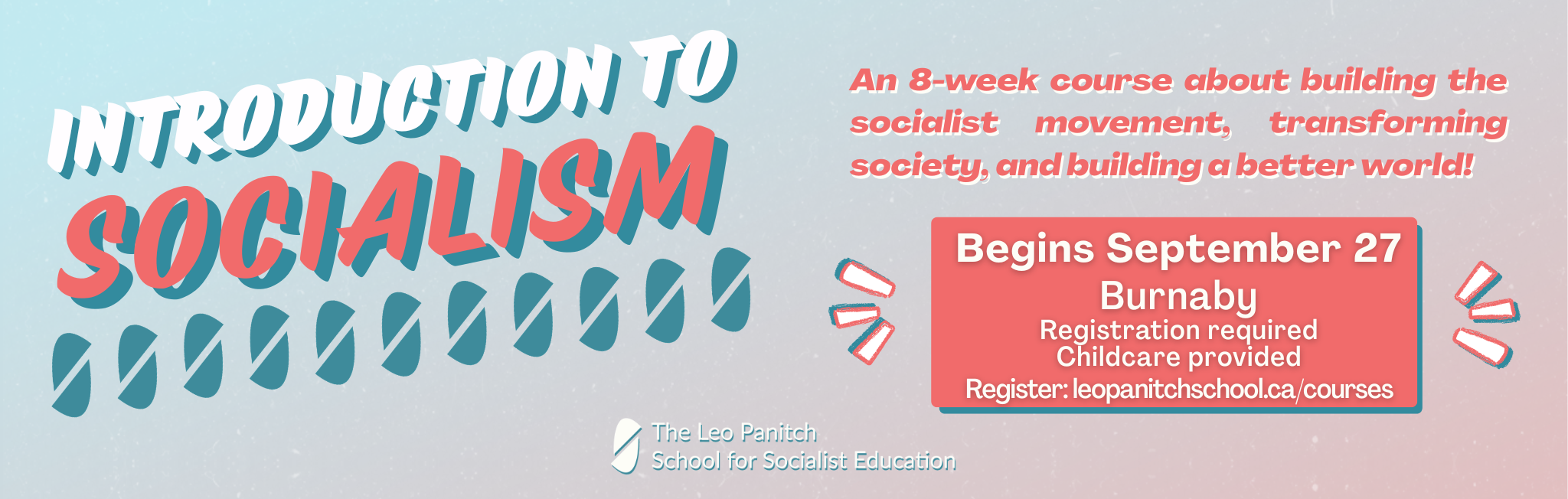
Curious about socialism? Interested about if it is really possible and taking a sober look at the problems it will face? Want to discuss how to begin affecting change right now?
In these uncertain and dangerous times, The Leo Panitch School for Socialist Education is a space to listen, discuss and challenge the contemporary relevancy of socialism.
The School’s flagship course, Introduction to Socialism, is designed for both those experienced activists always looking to learn more, and those newer to socialist ideas and full of questions. It will not only provide a unique venue for collectively tackling important topics, but also a welcoming space where any question relevant to socialist organizing, no matter how basic or advanced, can be raised and discussed.
Instead of providing exact definitions and historical readings, the course will focus on understanding the structures of capitalism in order to challenge it and begin building a better world. We will rely on the ideas and lived experience of participants to enhance the presentations, examples, and collective discussions that make up each session.
Over 8 weeks we’ll explore topics such as what and who is the working class, what makes socialism different, how we can overcome political barriers, how socialists can approach elections and winning reforms in the existing state, what role trade unions and political parties have played for working class struggles, and much more!
When: Sunday September 27, weekly until November 22. All classes 2:30-5pm (skipping Thanksgiving weekend)
Where: Jubilee United Church – 6000 Sussex Ave, Burnaby, BC V5H 3C2
Who: Anyone and everyone curious about socialism!
The Leo Panitch School has been running this and a number of other political education courses across Canada and online, as well as in our home base of Toronto since 2023. Now we’re very pleased to be hosting the course for a second time in the Greater Vancouver Area!
Please note that space for this course is limited. Therefore, individual participation will be confirmed after registration in order to ensure a variety of experience levels are present for the course.
Feel free to reach us with any questions at info@leopanitchschool.ca.
November 12, 2026
Toronto, ON
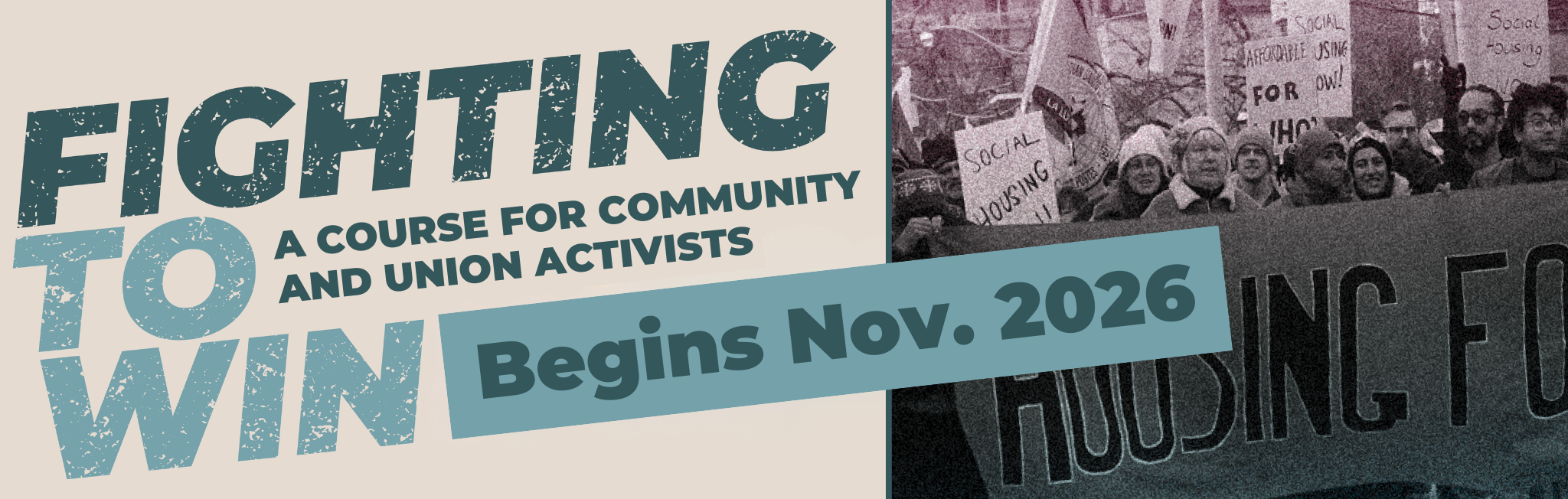
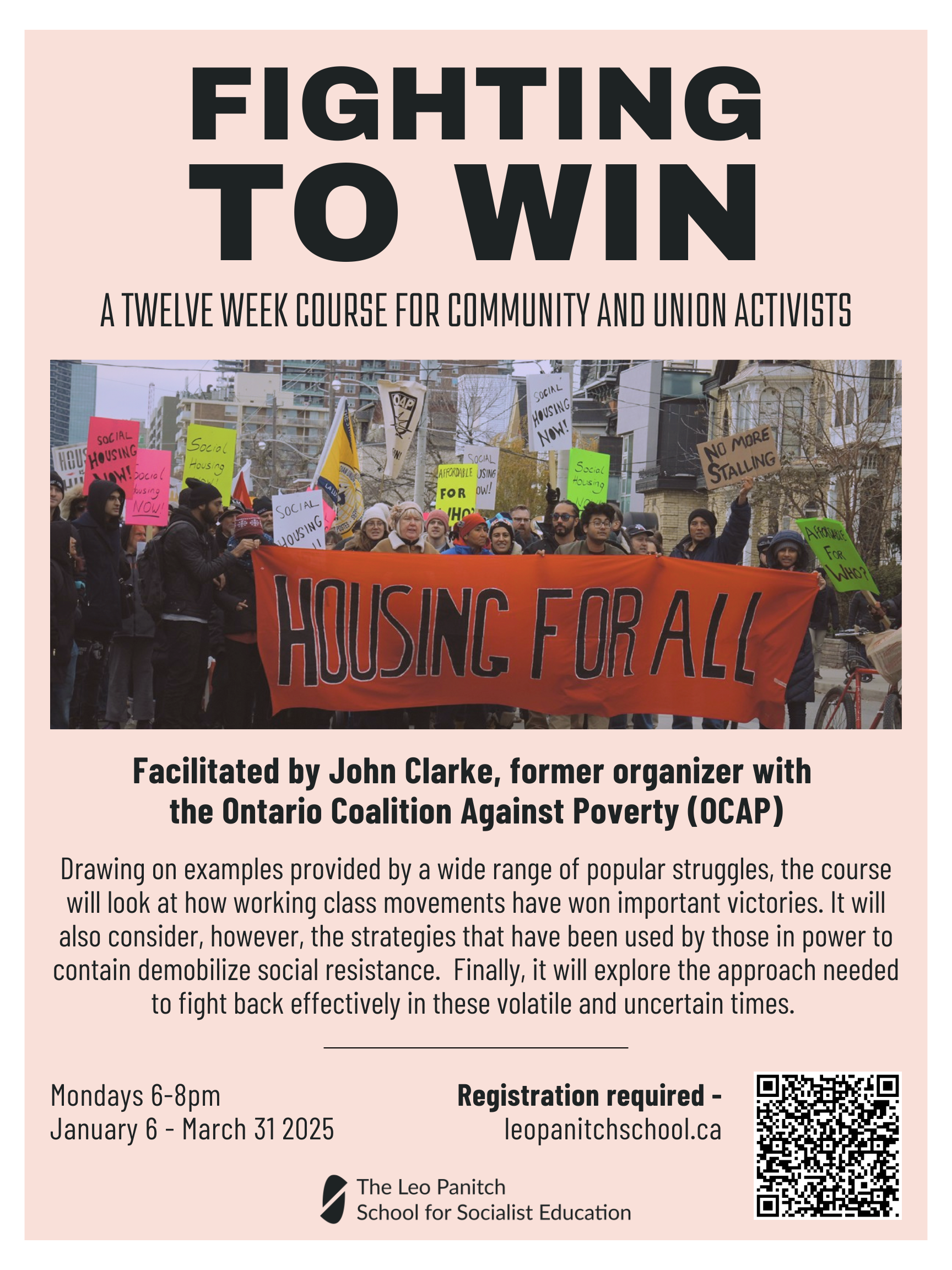
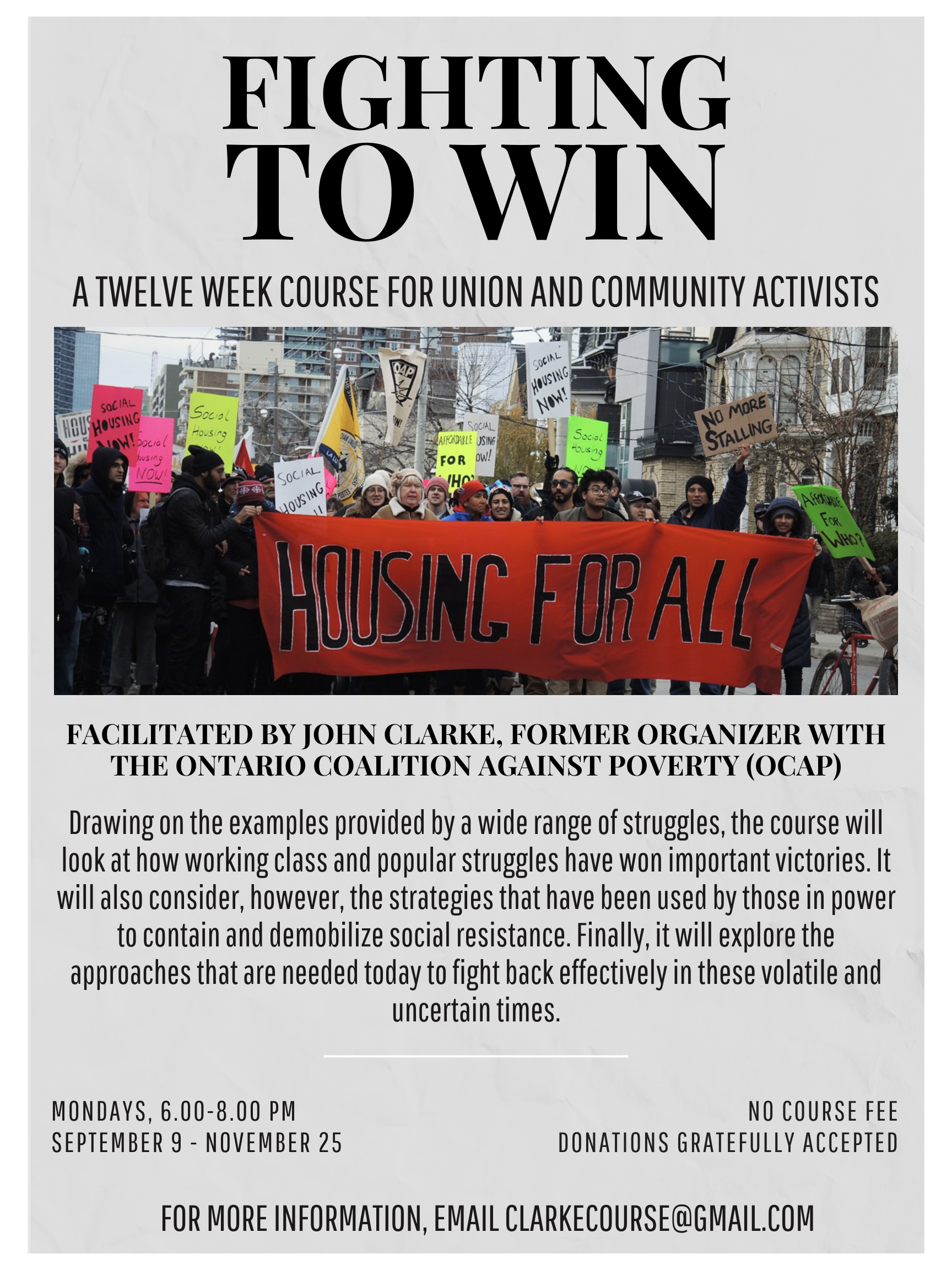
Unions and social movements today are operating under incredibly dire circumstances. There is great economic uncertainty and we confront the worsening impact of climate change as well as a global situation marked by the growing threat of conflict and war. When workers strike or communities under attack take to the streets, it seems that victories are much harder to win and past gains more difficult to defend.
This course will grapple with these questions by looking at the forms of exploitation and oppression that exist in society and the means by which the power structure acts to limit and contain our struggles. The course will move towards a discussion of how our movements can overcome the factors that hold them back and to fight to win!
This is not a ‘how to organize’ course, as important as these are. It is intended for activists who realize that the methods of struggle that were developed at an earlier time need to give way to more powerful and effective forms of social resistance.
Instead of lengthy lectures, each session will involve in-depth and participatory group discussions of the issues under consideration. The knowledge and lived experiences of those participating will be a vital part of the course. This will be true both for longtime organizers and for those just now dipping their toes in the world of activism.
When – Thursday November 12, weekly until December. All classes 6-8pm
Where -Downtown Toronto – Venue shared with registrants
How – Advance registration required
Cost – Free/recommended donation $20
This edition of the course has been condensed from its original 12 session form, into a new 4-week condensed course. Previous Fighting to Win students are welcome to take part, though space is limited and selections may be made to ensure a group with a variety of experiences is present.
Accessibility
The venue for this event is wheelchair accessible via an elevator that is available upon request. It features multiple gender neutral washrooms. We ask that participants refrain from wearing perfume or other scented products. Please contact us with any accessibility concerns.
October 17, 2026
Fredericton, NB
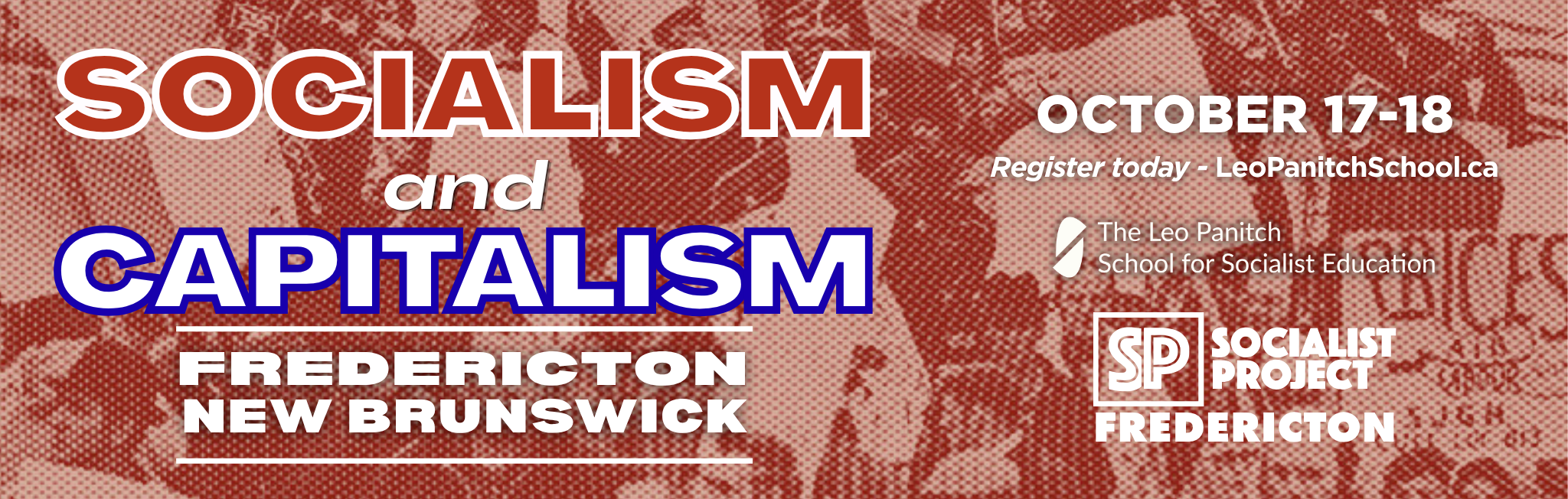
The Leo Panitch School for Socialist Education is thrilled to be supporting the latest edition of Socialism and Capitalism organized by Socialist Project Fredericton. This course is a new version of the course, now held over one weekend!
Over the two days we will examine the historical development of socialism as a response to the continual evolution of capitalism. We ask: “What is socialism now and how did we get here?” And we ask: “What is capitalism now and how has it changed?” All the while we trace the evolution of socialism as an analytical and political paradigm responding to the harmful and often violent effects of capitalism. Throughout our journey we will stress that the essence of socialism involves the desire to get beyond the horrors and trauma caused by capitalism.
This course will run 9:00am-5:30pm on October 17 and 9:00am-1:30pm on October 18. Participants are encouraged to attend the entire weekend, if able! Venue details will be shared with registrants in the weeks leading up to the course.
Full schedule can be found by clicking here.
This course is being offered free of charge or by optional donation. All proceeds will go towards the Leo Panitch School’s educational programming.
Pre-registration is required, as space is limited to 20 participants.
About the Leo Panitch School
The Leo Panitch School for Socialist Education was created in 2023 by members of the Socialist Project, an eco-socialist organization founded in Toronto. The school emerged at a moment when popular frustrations abound over inequality, the narrowing of democracy, the squandering of human potential, and the ever-clearer reality of impending environmental catastrophe. We strive to provide radical, accessible, and practical educational programming for those seeking to better understand and address the crisis of our current times.
The school is excited to supporting programming on the east and west coasts of the country, in addition to our regular events in our home base of Toronto.
Feel free to reach us with any questions at info@leopanitchschool.ca or info@spfredericton.org.
October 7, 2026
Toronto, ON
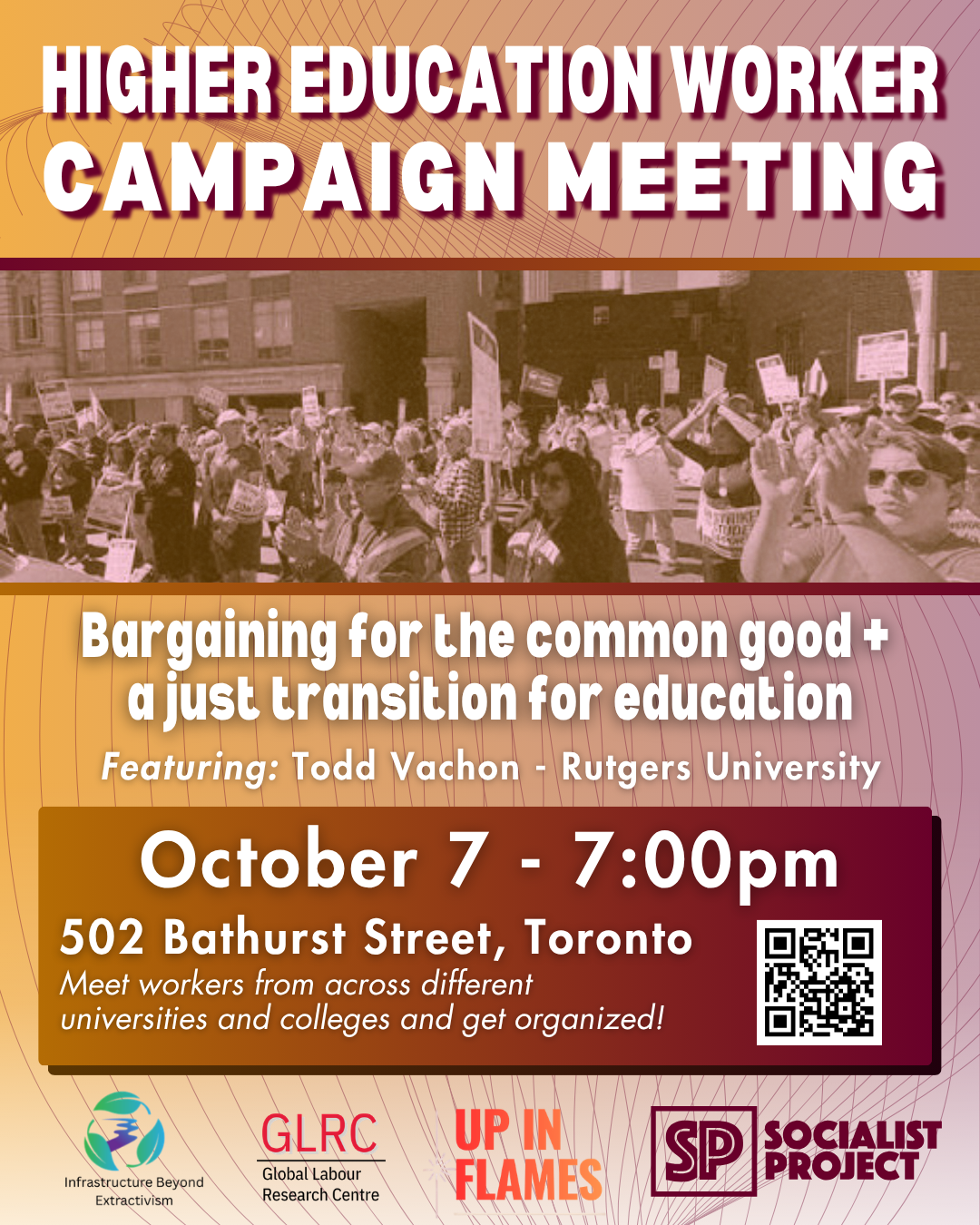
The Socialist Project’s Next Higher Ed Campaign meeting will be October 7 at College Street United Church at 7pm. We’ll be joined by Todd Vachon on the topic of Bargaining for the Common Good/A Just Transition for Education. We’ll also review the state of organizing in our sector and identify key goals for the campaign in the coming year!
Bargaining for the common good was popularized through teachers organizing in Chicago and West Virginia, fighting the sustained bipartisan attacks on public education, and linking gains at the bargaining table–like smaller class sizes–to the direct benefit of students and the community. It has been used to secure important climate wins, such as investments in solar infrastructure and energy efficiency upgrades, together with improvements in higher education. Campuses are major sites of greenhouse gas emission but also workplaces with huge potential to decarbonize, and our next meeting will consider how our unions could make gains in these areas.
Bargaining for the common good also serves as a means to make links with the disparate movements that intersect with campus labour issues which leaves questions of strategy for our Higher Ed sector wide campaign that we have to grapple with.
Todd E. Vachon is Assistant Professor of Labor Studies and Employment Relations and Director of the Labor Education Action Research Network at Rutgers University. He is the author of Clean Air and Good Jobs: U.S. Labor and the Struggle for Climate Justice.
This event will be a meeting for the Socialist Project’s Higher Education Worker Organizing Campaign. The event is being supported by our friends at the Global Labour Research Centre (GLRC) and Infrastructure Beyond Extractivism, as a part of their collaborative workshop series, Up in Flames.
November 21, 2026
Toronto + Online
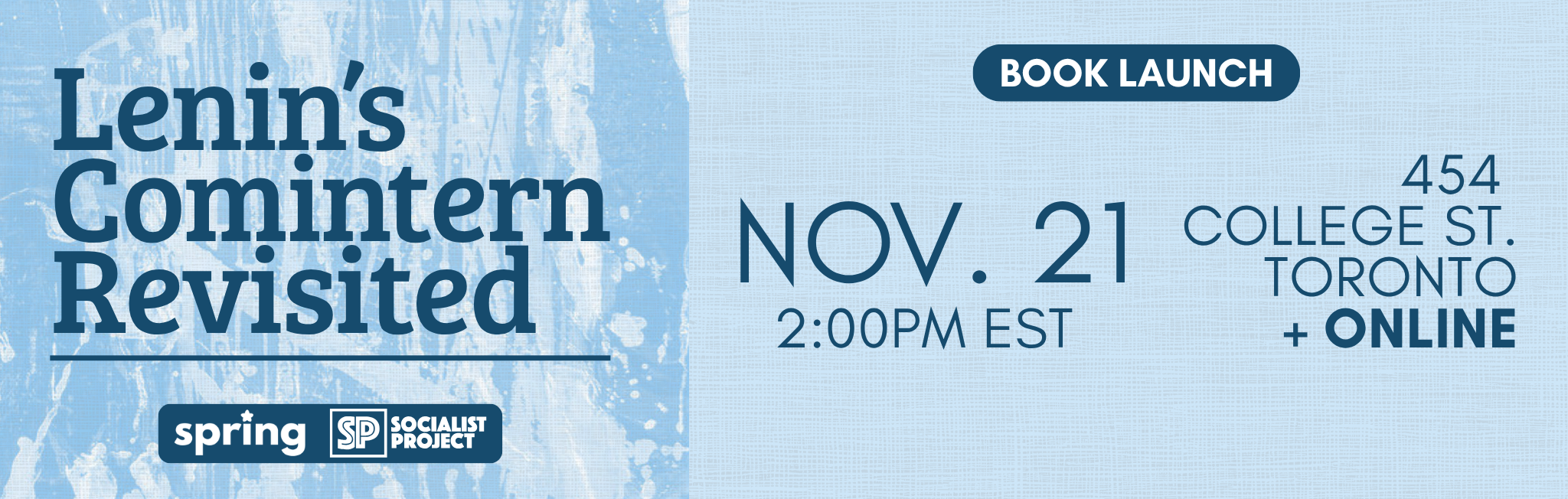
Please join us for the launch of the soft-cover version of John Riddell’s Lenin’s Comintern Revisited (Haymarket Books), and discuss lessons from the period of the Communist International for today’s movements and struggles.
The Communist International (or ‘Comintern’) was launched in 1919 to promote worldwide extension of the 1917 workers’ and peasants’ revolution in Russia. During the Comintern’s first years under the leadership of V.I. Lenin, it proposed and tested strategic and tactical concepts that retain their value and continue to be studied. While the Communist International was soon to be deformed and destroyed by the rise of bureaucracy and authoritarianism associated with Stalinism, its perspective on the fight for international revolutionary change still presents a compelling vision, and is an inspiring example for millions throughout the world.
Lenin’s Comintern Revisited is the latest volume in the Comintern publishing project and another monumental achievement for John, his co-editor Mike Taber, and all those involved in preserving this important part of revolutionary history. It represents the culmination of a decades-long project to make available the proceedings of the congresses of the Communist International (comintern) held during Lenin’s time.
When: November 21 – Doors open: 1:30pmEST, Event start: 2:00pmEST
Where: College Street United Church, 454 College Street, Toronto (map) + Online
How: Please register via the event page
Cost: Free/by donation (to make a donation, select “Free Admission” and type an optional donation amount during check-out).
Please stick around after the event for a reception, book signing, and complimentary refreshments! We are pleased to have our friends from Another Story Bookshop join us with copies of the book and other great titles for purchase.
This event is being co-organized by Spring Magazine and the Socialist Project, with assistance from the Leo Panitch School for Socialist Education. To endorse, please email secretary@socialistproject.ca.
SPEAKERS
Panel to be announced
John Riddell is an essayist, historian, editor, translator, and lifelong activist. He is the editor of The Communist International in Lenin’s Time, a multi-volume series of books of Communist International documents, many of which translated into English for the first time.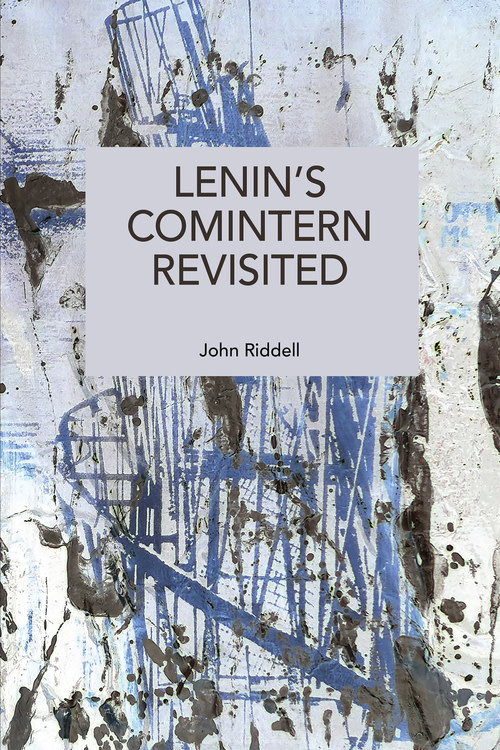
Accessibility
College Street United Church is located at College and Bathurst in Toronto. The building is wheelchair accessible and features multiple accessible, gender neutral washrooms. We kindly ask all attendees to refrain from wearing scented products.
Any questions or requests regarding accessibility, participation, or programming can be directed to info@leopanitchschool.ca.
November 6, 2026
Toronto, ON
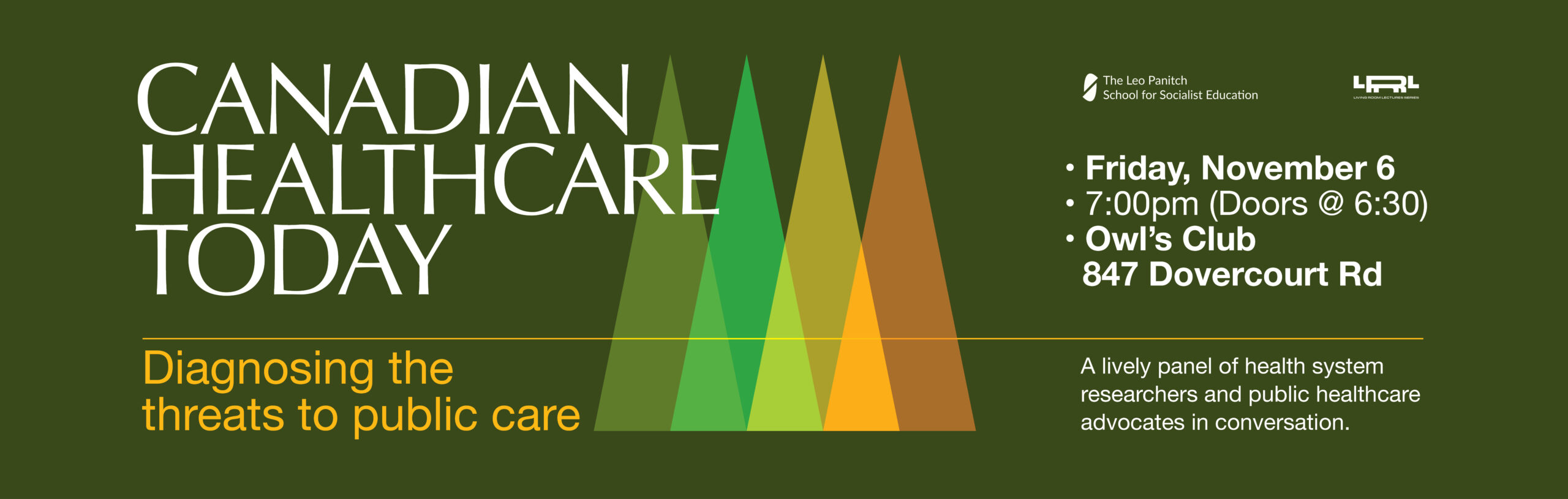
Since its inception, Canadian healthcare has provided the vast majority of Canadians with medical services free at the point of care and provided by both public and private actors. However, this system has long faced compounding challenges, including: cost-containment, chronic health human resource shortages, prolonged wait times and the rise of “hallway medicine”, and systemic racism in healthcare delivery.
Over the last few decades, these challenges have increased as federal and provincial governments have clawed back funding, laid off workers, and the use of new forms of private, corporate actors to fill gaps in care.
This educational panel event, hosted by the Leo Panitch School for Socialist Education, brings together health system researchers and public healthcare advocates to shed light on these critical developments and how we can push back on privatization and systemic racism within our healthcare system.
SPEAKERS
(Moderator) Matthew Tracey is a registered nurse, and a doctoral candidate in Health Systems Research at the Institute of Health Policy, Management and Evaluation.
Dr. Danyaal Raza is a family physician with Unity Health Toronto’s St. Michael’s Hospital, and an Associate Professor with the University of Toronto. He is the inaugural Primary Care & Health Policy Scholar at St. Michael’s Department of Family & Community Medicine. His writing, research and media commentary focus on health system reform, and the effects of commercial determinants on change.
Dr. Vanessa Redditt is a family physician at the Crossroads Refugee Clinic, a specialized primary care clinic for refugees at Women’s College Hospital, and a lecturer at the University of Toronto’s Department of Community and Family Medicine and Dalla Lana School of Public Health.
Nicole Luongo is the Canadian Drug Policy Coalition’s Policy and Systems Change Analyst, where she advocates for evidence-based drug policies that are grounded in public health and human rights. The overarching purpose of her role is to move the conversation on drug policy toward models of legal regulation. She is guided by experiential knowledge of criminalized drug use, involuntary treatment, and homelessness and has spent a decade and a half working in solidarity with those most impacted by punitive drug policies, including as a member of the Vancouver Area Network of Drug Users (VANDU). Before joining CDPC, Nicole taught college-level sociology. She continues to publish in the fields of Mad and Critical Drug Studies.
When: November 6 – Doors: 6:30pm, Start: 7:00pm
Where: Owl’s Club, 847 Dovercourt Road, Toronto ON
How: Please register via the event page
Cost: Free/by donation
Please stick around after the event for refreshments, music, and socializing!
Accessibility
Please get in touch with us for information regarding specific accessibility information for this event, including the use of mobility devices. Any questions or requests regarding accessibility, participation, or programming can be directed to info@leopanitchschool.ca.
We kindly ask all attendees to refrain from wearing scented products.
Missed an event?
Check out LeftStreamed for recordings of past Leo Panitch School events and much more!
Watch nowPast Event Poster Archive